|
Return
Me
to Mistwillow
by
Terry
Wright
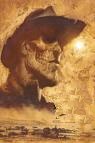
Windblown dust swirled down Main Street
as Jake Stratton made his way past wood-plank buildings toward Mistwillow’s
trading post. Weary bones
ached. His hollow chest
panged. Another morning had
gone by and still there’d been no word from his son.
Wearing ashen gray clothing, passers-by nodded.
Gentlemen tipped dusty hats, and ladies curtseyed, even as the
wind tore at their soiled gowns.
“Good afternoon, Jake.”
He grumped, knowing they were only trying to be nice, to be upbeat and
hopeful in spite of the fact that his son was missing.
Robert was a fine boy, ten years old and destined to run the
family store--until that fateful day, November 7, 1882.
“Telegraph lines still down?” a man asked as they crossed paths.
“Damn storm,” Jake replied. He’d
never seen anything like it, day after day, year after year, the wind
and dust ever-present, the sun but a smudge in a gray sky.
Mistwillow,
Colorado, once bustling with miners and traders and wagons and horses, had
become a colorless, odorless scar on the land.
“Maybe the stage will be in today,” the man said and moved off, the
tempest swallowing him.
Jake knew the stagecoach hadn’t stopped here in years, a hundred and
fifteen, to be exact. So why
would it come today? And if
such a miracle were possible, then Robert would be on that stage,
stepping down from the coach, waving to a relieved crowd.
The sky would clear, and marching bands would play.
Tumbleweeds rolled by. Their whish-whish-whishing sound broke Jake’s reverie. Turtling his
neck, he strode the boardwalk, fought the sting of tears flooding his
dry eye sockets. “Robert,
when are you coming home?” The
question went unanswered, as usual, and not knowing sustained Jake's grief
each hour of every day.
He came to the sign that hung from beams under his storefront porch: Stratton’s Trading Post, Established 1853.
With dirt grating his throat, he entered the store, bell tinkling
behind him. His boots
scattered inch-deep dust, dust that blew in through broken windows.
One day he planned to sweep.
One day he planned to fix the windows.
One day when Robert comes home.
Marianne, wearing her best Sunday dress, gray with dust, greeted him
from the stockroom door. “Any
word?”
“Nothing.” He walked to the sales counter.
“No telegram, no mail.”
She wiped a glass with a dusty rag, but the glass didn’t get any
cleaner. “Maybe
tomorrow.”
“If tomorrow ever comes.” He’d
spoken those words every day since Robert disappeared.
And every day Marianne offered the same hope for tomorrow.
In fact, every day she wore the same dress, and stranger still, she hadn’t aged a
day.
A dizzying sense of déjà
vu hit Jake like a board. “What
happened to us, Marianne?”
“Eerie isn’t it, the storm?”
It was more than that.
“Day in, day out, nothing ever changes around here.”
“Don’t be loony.” She
set down the dirty glass, picked up another and began wiping it,
unconcerned that her efforts were futile.
“Things change enough for me.”
“You don't even change your clothes.”
“Why this old dress? It’s my favorite.” Then she scowled.
“When’s the last time you wore anything different?”
Looking down at his dusty pants and threadbare shirt, he couldn’t
remember owning any other duds. A
bath would be nice. He sniff-checked his armpits. Didn’t smell bad.
In fact, he didn’t smell anything at all, or taste anything,
either. “We never drink,
we never eat--”
“We never touch,” she put in, “like husband and wife.”
He missed her in that way, more than the taste of cold beer or a juicy
steak. But he wouldn't speak of such personal topics. “You
know how I feel about you.”
“Then stop your complaining. Change
could ruin everything.”
“Worse than this?” He
leaned against the counter and surveyed his inventory of goods awaiting
buyers. Stacked shelves of
flour, wheat, beans, and jerky lay in dusty ruin.
Wilted dresses hung from wall pegs like gray ghosts.
Spider webs adorned the boot rack, and the pickle barrel had
rotted out long ago. Not a
single customer had come in, not a miner, not a trader, not a Ute or
Cheyenne. Not since November 7,
1882.
Jake spit dust, grappled with yet another day of failure.
“It’s my fault.” He
slumped onto a stool at the counter, dirt puffs flying.
“There you go again,” she said, rubbing the filthy glass.
“Don’t blame yourself for what happened to Mistwillow.”
Head in hands, he remembered how soldiers had rounded up all the
Indians and herded them off to reservations.
Half his trading business was gone with a snap.
“I couldn’t fight the army.”
“And it’s not your fault the gold rush ended so soon.
Most miners headed south to Cripple Creek
or west to California.”
Another twenty-five percent of his business had moved away.
“And the beaver,” He recalled thousands of pelts
traded across this dusty counter. “They’re
so scarce now, trappers moved north to Wyoming
and
Montana.”
“So, we’re in a little pinch.”
She gave up on the dirty glass, grabbed another and rubbed it
with vigor. “There’s
nothing you could have done about it.”
Jake knew the town of Golden, to the south, flourished, having established the
nation’s first commercial gardens, which supplied wheat to three flour
mills on Clear Creek.
Boulder to the north became a center for education as the first
Colorado schoolhouse opened there. And
to the east rose the metropolis of
Denver, the new hub of Rocky
Mountain
commerce. All Mistwillow had
left was this trading post, but no customers--not a living soul.
“How much longer do we have to go on like this?”
“At least we have each other.”
“I wish Robert would come home.”
“Careful what you wish for, Jake.”
Wind screamed through broken windows.
He watched the sheet almanac sway.
Suspended from a beam with twine, it hung over the counter for
easy reference. The last
sheet read “Election Day. November
7, 1882.” Somehow,
time had stopped in Mistwillow. He
wanted to rip off the page, tear it up, but he couldn’t destroy his
only link to his son.
He never should have come to Colorado. That’s what George
Stratton thought as he drove the rented ‘97 Ford Expedition north out of Golden. A
steady stream of traffic flowed in both directions on Highway 93.
November air felt mountain crisp, the sky a cloudless blue, the
perfect day for a final farewell to Grandpa Robert.
Riding shotgun, Carol fussed with a map. "I don't see Mistwillow
anywhere." Her voice seethed with frustration.
“Look closer.” George didn't dare glace at the map himself. He had
to keep a watchful eye on the traffic-clogged winding road. “It’s
gotta be there somewhere.”
An oncoming semi blew past, buffeting the SUV.
Carol wadded the map like old newspaper.
“This is a damn waste of time.”
“Shh! Don’t swear in
front of Grandpa Robert.” George
indicated the back seat where he’d fastened a safety belt across
Grandpa’s upright ceramic urn.
“You’re crazy as the old man.”
“He was smart enough to finagle us into doing this.”
“Don’t remind me.”
Grandpa had left a final wish in his will:
Ashes to ashes.
Dust to dust. Return
me to Mistwillow.
He was cremated fifteen years ago.
Since then, his urn sat on the mantle, awaiting the right time
and circumstances for a trip to
Colorado. Grandpa Robert had been
specific: his ashes had to be spread on November seventh.
Any year. Didn’t
matter. But only in Mistwillow,
somewhere on the road between Golden and
Boulder.
George sighed. “I wonder why this town was so important to him.”
“He made it up.”
“And why today, November seventh?”
“Are you listening to me?”
Okay! He had to admit
something wasn’t right about Grandpa Robert.
Kooky. That was the
best way to describe him. Actually
he wasn’t just a grandpa; he was more like a great-great-great
grandpa. He’d lived to be
a hundred and nine, his mind sharp as a pin when his heart gave out.
All those stories about being raised by Ute renegades, robbing
trains, taking a squaw at fifteen, nobody believed any of it.
And now this, Mistwillow, a town that didn’t exist on the map.
But George was hard-pressed to believe Grandpa would put a lie in
his last will and testament. The
place where he’d spend eternity was at stake.
George had to give him the benefit of the doubt.
“There’s gotta be a sign along here somewhere.”
A red sports car passed him doing ninety.
Carol crossed her arms. “It’s
a wild goose chase, I tell you.”
“Just keep your eyes peeled.”
Rounding a curve, George tapped the brakes, an instinctive reaction to a dust storm blowing across the
highway up ahead. Speeding southbound
traffic emerge from the dirty gray cloud as if it wasn't there.
Clenching his molars, George gripped the steering wheel as he watched
the red sports car disappear into the storm without even slowing down.
George braked harder, but the dust swallowed the Expedition in a blinding gray fury.
Just as suddenly, the paved highway dropped off to a bone-jarring dirt
road.
Grandpa Robert’s urn
tipped over.
“What the hell is this?” George
didn’t know whether to stop or press on.
The thought of being rammed from behind forced his foot
off the brake. Blowing dirt
must've covered the pavement like drifting snow; they’d be
through it in a few seconds. He
held his breath, but there seemed no end to the storm.
Odder yet, he hadn’t seen a single vehicle traveling either
direction. They were
suddenly alone in a tunnel of churning dust.
His throat seized.
“There,” Carol shouted, pointing.
“The sign--it’s the sign.”
Nearly obscured by whirling dust, a lone wooden post held up a
crooked, jagged-edged board with the word Mistwillow scrawled on its face
as if it were written with a trembling hand.
“How about that.” He
swallowed dryly. “Grandpa
wasn’t crazy after all.”
“It’s not on the map, George. It
can’t be real.”
“Seeing is believing.” He cocked his head to the back seat
urn. “We found it,
Grandpa.”
“Turn around, George. I’m
not kidding.”
“He’s going to get his final wish, honey, his ashes scattered in the
wind of Mistwillow.”
“Go back!”
The Expedition sped past the sign. It teetered and fell over.
“The stage is comin’ in,” someone shouted down Main Street. “The
stage!”
Jake shot up from his stool at the counter.
“Hear that, Marianne? The
stage. It’s coming.
Robert’s home!” He
made a dash for the door.
She dropped the glass she’d been wiping.
“No, Jake. Don’t
go out there!” With the
speed of the wind, she reached the open doorway first and blocked his
exit.
“It’ll be the end of Mistwillow, the end of you and me...”
Citizens gathered in the street, their gray and dusty faces wrenched
with concern.
“--And them.”
From the swirling dust cloud, the roar of hooves pounding earth drew
nearer.
“My son is on that stage.”
“Our son.” She grabbed the front of his tattered
shirt. “He’s the only
reason we’re still here. We
exist in your grief, Jake.” She shook him.
“Without that, we’re nothing.”
“But I want him back.”
“And sacrifice us all?”
“What’s to lose, Marianne, this eternal dust and wind, thirst that
can’t be quenched, hunger that can’t be satisfied, our passions
unfulfilled?”
“It’s better than nothing, Jake.
Let the stage pass.”
His sunken eyes hardened to granite. “I can’t.”
He pushed
her aside and stepped out on the boardwalk.
This was the moment he’d been waiting for, the miracle, and no
amount of nagging would keep him away from that stagecoach.
Marianne slipped around him, put a hand on his chest.
“At least let the people of Mistwillow have a say.
You owe them that much.”
“Their fate is already sealed. I
don’t owe them anything.” He
turned to address the crowd.
“My son is home. Our
day of rejoicing has come.”
“Your day,” a man shouted from the dusty street.
“Your day, Jake Stratton.”
“We made our peace,” a woman put in.
“Now you make yours, Jake.”
Pounding hooves, snorting nostrils, and creaking leather approached at a
heart-throbbing pace. After
all these years, he was about to see Robert again.
He could hold his hand. Hug
him. They could toss a ball
and go fishing under clear blue skies.
“Meet the stage, Jake,” someone else shouted.
“Go to your son.”
Marianne jumped in, “But Mistwillow will be destroyed.”
“A little late to worry about that, don't you think?” November 7th 1882,
the largest earthquake in Colorado history had leveled Mistwillow.
There were no survivors, except Robert. He had gone to Denver that day.
The dust cloud parted. Six
black stallions in silver harness broke through, knees rising with
mechanical precision, hooves coming down like pistons striking the
ground. The driverless coach
thundered up to Stratton’s Trading Post and groaned to a stop.
“Go on, Jake,” someone said. “Open
the door.”
He looked over the gray faces of his fellow citizens, saw relief in
their windswept eyes. “Thank
you,” was all he could say, but he said it from the bottom of his
tormented soul. He turned to
Marianne and hugged her. “And
thanks for helping out with the store.”
“Don't do it, Jake Stratton.”
He kissed her sunken cheek and stepped off the boardwalk.
At the coach door, he grabbed the smooth handle and felt a tremor
in the ground under his feet.
“It’s a ghost town,” George said as he parked the Expedition in
front of a broken-down building with a boardwalk, its wood planks rotted
with age. A canted sign
swung in the wind: Stratton’s Trading Post.
His stomach knotted at the sight. Mistwillow,
dusty and eerie, its main street lined with leaning and weathered
buildings, was obviously part of his past, his heritage perhaps, something Grandpa Robert had
wanted him to see. But why?
What was the old coot thinking?
“Creepy,” Carol whispered. “No
wonder it’s not on the map.”
Tumbleweeds rolled across the deserted street.
As George watched out the windshield, he felt disjointed from
reality, somehow transplanted to a bygone era.
Dust collected on the hood. Already
the Expedition’s black finish looked powder gray.
“Let’s get this over with.” Carol shoved open the door.
“I want to go home.”
A gust of wind swirled in.
Turning to the back seat, George saw the tipped-over urn.
The lid had fallen off. Grandpa’s
ashes were spilled on the seat. The
remainder was still salvageable, he reasoned; set the urn upright, take
time to say a few words before spreading Grandpa’s ashes.
But before he reached back to grab the urn, he saw Carol fighting
the wind as she took hold of the back door handle.
“Wait!”
She opened the door. Howling wind rushed in
and blew open the opposite door, creating
a wind-tunnel effect that flung the urn out, shattering it on the ground.
Grandpa’s ashes suddenly became indistinguishable from the
blowing dust.
Fighting panic, George jumped out, scooped up dust and ash, and let the
mixture sift through his fingers. Ashes
to ashes. Dust to dust.
Return me to Mistwillow.
He looked up and down the windblown street, felt a presence he
couldn’t explain. “What
are you up to, Grandpa?”
Ground rumbling, Jake opened the coach door.
The dark interior beckoned him.
He moved closer, either out of curiosity or fear; he didn’t
know which: curiosity of seeing Robert there, or the fear of Marianne
being right about Mistwillow's final demise.
“Robert?”
The earth lifted and heaved.
“Are you in there?” He
held on to the rocking coach, heard wood planks crack behind him.
“I’ve waited a long time for you.”
“Father?” The voice of
an angel emanated from the doorway.
“Where am I?”
Jake couldn’t hold back his tears.
“Mistwillow, son. Let
me have a look at you.”
A gust of wind blew dust from the coach.
As the cloud dissipated, an old man appeared before him, stooped
over, warty chin, nose bent, and hairy nostrils flaring.
“I knew you’d be here,” Robert said in a gravelly voice, his
bushy gray eyebrows cocked at an angry slant.
Stepping back in disbelief, Jake felt only repulsion for the creature
standing before him. Where
was his ten-year-old boy, the blue sky, and the marching bands?
“You’re not my son.”
“My name is Robert Stratton,” he rasped. “That makes me your son,
Daddy!”
The ground shook.
“You can’t be.”
“I’m a hundred and nine years old.
What did you expect?”
Buildings splintered and crashed to the ground.
Falling debris crushed panicked Mistwillow citizens.
“I want my son back!”
“Daddy, I’m home!” Robert spread his arms like Jesus
Christ. “This is what you
get for killing my mother.”
A porch beam fell on Jake, knocking him over.
Marianne ran to him, knelt at his side, held his hand.
“Why did he say that, Jake?”
Robert cackled.
“Wanta toss the ball, Daddy? Wanta go fishing?”
“He blames m-me,” Jake sputtered, “that you died that day.”
“It was an earthquake. How
could he?”
Jake coughed up dust. “Robert wanted us to go with him ... to
Denver
... to the horse show ... but
the store needed a good dusting.”
Jake now realized the irony of his miserable existence.
“He begged me to let you go instead, but I wouldn’t allow
it.”
The ground quaked, split like forked lightning.
“Hold my hand, Daddy. You
got what you wanted! Give
me a hug.”
Clinging to his wife’s arm, Jake feared spending eternity with his
crazed son. Only now did he
understand his mistake. “We
should’ve gone to Denver, Marianne, but the store was more important to me than spending time
with my son.”
“It’s not your fault.”
“I’m--”
“Don’t say it!”
“--Sorry.” Jake’s
grief turned to guilt, breaking Mistwillow’s fragile bond.
Marianne screamed, crumpled to dust, and along with the entire town
swirled away with the wind. Robert
collapsed into a heap of gray ash and was gone.
The last thing Jake saw, his skin peeling off, his hand and arm
bones dissolving, and then nothing.
The earth lunged one final time, cracking plaster walls in downtown
Denver, the
Boulder
depot, and on the
University
of
Colorado campus. The
6.2 trembler was felt from
Salina,
Kansas,
to
Salt Lake City, Utah. Mistwillow
was forever lost.
The blare of a truck horn sent George scrambling for the ditch.
“What the hell?” He’d
damn near gotten run over. The
highway had reappeared, the sparkling clean Expedition parked on the
shoulder. Traffic whizzed
by. He shook his head, tried
to get a grip on what he’d just witnessed.
The dust storm was gone. And
Carol, too.
Carol! Where did she go?
“Carol!” Heart
pounding with dread, he scanned the highway up and down but didn’t see her.
“Carol!”
“George!” She emerged
from the other side of the SUV, windblown hair but otherwise unharmed.
“Are you satified now?”
“Get in." He ran to the open driver's door, jumped in behind the wheel.
Carol joined him and buckled her
seatbelt. “What just
happened?"
“A bad dream.” He started the engine. “But
you saw it too, right? Mistwillow.”
“I don't know what I saw.”
He turned to the back seat. The urn was gone.
A creepy-crawling feeling skittered up his spine. Everything had happened just as he’d seen it.
Grandpa had gotten his last wish.
“Let’s go home, George. It’s
over.”
“Is it?”
He floored the gas and merged with traffic heading south
under a beautiful blue
Colorado
sky.
|

