|
This
story is based on the 1997 murder of Michelle Moore-Bosko in Norfolk, Virginia.
Unbelievably, seven young men confessed to the crime. Even after the real killer
was identified, the district attorney proceeded against four of the men. Two
plea bargained, accepted life sentences to avoid the death penalty. Two went to
trial. The juries convicted them on their recanted confessions alone, in spite
of the fact that DNA evidence, or the lack of it, proved they weren't involved. Any
reasonable person would assume that something went wrong with our system of
justice. Now it's up to Justin Graves to set things right in this fictionalized
account.
False
Confessions
by
Terry
Wright
Michelle was 18 years old when she died. A bride of three
months, she had married a young Navy seaman who was away on a training
cruise when she was murdered. A Southern girl, deeply devoted to
her husband, her only regret when she passed from life into death was that she
wasn’t able to meet him at the dock when he returned from sea. Because of her
religious convictions, she had easily crossed over to everlasting peace and
happiness.
Normally, those who cross over don’t come back;
not that they can’t, they just don’t. Earthly concerns have no merit
anymore. Nothing matters. However, in Michelle’s case, the bizarre events
surrounding the investigation of her murder distressed her so much that she had
to meet with Justin Graves.

In
the afterlife, where tormented souls were purged and purified, Justin settled
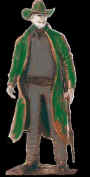
back in a nice chair that the light had supplied him. He wore his favorite long
brown coat, black polished boots, and perfectly shaped cowboy hat. A Texas
Ranger star gleamed brilliantly from his lapel. Clean-shaven and smelling of
Stetson cologne, he was looking forward to a relaxing evening with his new copy
of Police Journal magazine, which the light had supplied also.
“What
do we have here?”
he mused.
Dim
and churning, the foggy light closed in around him. A deep voice said, “Turn
to page twelve, Justice.”
There,
Justin found a story about a homicide detective who had the unprecedented
reputation of solving every murder case he’d ever investigated. Detective Ben
Ford was a legend in his own time. He was an expert in criminal psychology and
profiling. His knack for getting suspects to confess bordered on genius, the
article read.
“Impressive,”
Justin said. “Especially this case here.” He pointed to a crime scene photo
of a stabbed female corpse sprawled on a hardwood floor. “One murder, eight
confessions.”
“That’s
right,”
the
light replied. “But seven of those confessions were coerced. Seven suspects
are innocent.”
That
turned Justin’s stomach. He hated injustice more than he hated crime. “How
could that have happened?”
“They
had one thing in common, the interrogating detective.”
Justin
nodded. “Detective
Ben Ford.”
“Someone
is here to see you,”
the light announced and parted, revealing a stooped young woman with tears
streaming from her eyes, her face wrenched with sorrow, her long brown hair in
tangles. Justin could feel the intensity of her grief, in his soul, and because
of the white robe she was wearing, he knew she had come back from the other side.
“My
name is Michelle,” she said in a ragged voice and stepped forward.
Justin
took off his hat and rose to his feet. He immediately recognized her as the dead
woman in the crime scene photo. “You know something about Detective Ben Ford?” he asked, the
Police Journal in his outstretched hand.
“Jimmy didn’t do it,” she
said, shaking. “He lived across the hall. After my husband discovered my body
on the bedroom floor, he ran screaming to Jimmy’s apartment. Jimmy called 911.
When the detectives arrived, he agreed to go to the police station to answer some questions.
Unbelievably, Detective Ford got him to confess to killing me.”
“Confession is the queen of
all proofs,” Justin said.
The light offered up a chair.
Michelle sat, damping her tears with a tissue the light had also supplied.
Satisfied she was comfortable,
Justin let the magazine float in the air between them and returned to his seat.
“Why did he confess if he didn’t do it?”
“Only after fourteen hours of
interrogation,” she said. “Detective Ford wouldn’t let him go to the
bathroom, wouldn’t give him a drink of water, and wouldn’t let him sleep. He
beat him, threatened him with the death sentence if he didn’t cooperate.”
“And this is documented?”
asked Justin, setting his hat on his knee. “It’s highly unethical.”
“The detective had a
different account of how the interrogation was conducted. All lies...like when
he told Jimmy he’d failed the lie detector test when he didn’t, told him his
fingerprints were on the murder weapon when they weren’t.”
“The police are under no
obligation to tell the truth,” Justin replied, “Biased, they assume they are
interrogating a guilty person, so they resort to trickery and deceit to get a
confession. It’s standard operating procedure laid out in the Criminal
Interrogation and Confession handbook.”
“But Jimmy caved under the
pressure,” she said. “He just wanted out of that room; he was afraid the
detective was going to kill him. Besides, he thought they’d let him go after
they found that his fingerprints and DNA didn’t match the evidence left at the
crime scene…he knew he wasn’t there; he knew he was innocent.”
“Unfortunately, innocence is
not a defense,” said Justin.
“When the DNA test
results came back, they didn’t match Jimmy’s. That’s when Detective Ford
knew there was someone else involved, so he found another suspect who also lived
across the hall from me. They interrogated him for hours until he confessed and
unwittingly implicated another man who later confessed, too.”
“Three killers?”
“They weren’t even there,
Justice. And sure enough, their DNA didn’t match either, so the men were brought
back in, and before Detective Ford was finished with them, three more innocent
men were implicated, arrested, and interrogated. They too all confessed after
untold hours with Detective Ford, but in the end their DNA didn’t match
either. Even their accounts of what happened that night didn’t match each
other’s or the physical evidence: the method of entry, the stab wounds, the
murder weapon. You’d think Ford would’ve backed off after that, but no, he
simply revised his version of what happened that night by adding more men in my
bedroom raping and killing me.”
“How many?”
She hung her head. “Seven.”
“And the real killer?”
“He was caught almost two
years later.” She looked up, tossed back her tangled hair. “His DNA
matched the evidence. His fingerprints matched those on the murder weapon. He said Jimmy and the others were stupid; they weren’t
there.”
“So all’s well that ends
well,” Justin surmised and put on his cowboy hat.
“But it didn’t end
there,” she said, clenching her fists in her lap, crushing the tear-soaked
tissue. “Detective Ford wouldn’t back down. He wouldn’t admit he was
wrong. The District Attorney stood by him, and the cases went to trial anyway,
on the strength of those false confessions alone, without a shred of
evidence.”
Justin understood. They didn’t need evidence if they
had a confession.
“And get this,” she said.
“The jurors weren’t told that the real killer was caught. They only heard
the false confessions. They were told that no one would confess to such a
heinous crime if they weren’t guilty. Any normal person on the jury would believe that,
especially if they’d never been through a sophisticated police interrogation.
Because of Detective Ford, those innocent men are in prison, some for as long as
two life terms. It isn’t right, Justice.” She pointed to the floating
magazine. “Detective Ben Ford has to be stopped.”
At police headquarters,
Detective Ford reported for duty. Everything about his appearance was precise
and professional. His gray suit was perfectly pressed and spotless, his tie tied
exactly right, his face cleanly shaven, and his black hair cut military short.
Anyone who knew him would say that he was a perfectionist, a neat freak. He was
anal retentive to the point of annoying. However, he was the best detective in the
department.
The captain summoned him to his
office.
“Yes, sir.”
“Did you see this?” The pudgy
captain with heavy jowls pushed the latest copy of Police Journal across
his desktop. “You’ve put this department on the map, detective. Good work.
I’ve received calls from all the major newspapers, and the mayor has promised
us more funding. We’re heroes.”
“All in the line of duty,
sir.”
Now the captain leaned forward,
frowning. “If one word of this gets out…”
“There’s no proof we did
anything wrong,” Ford cut in. He knew his boss was referring to the latest
confessions he’d gotten from Jimmy and the others and the way he’d gone about
getting them. “We’re not required to video tape or record interrogations,
and nobody in this department will say anything to discredit us.”
“It’d ruin everything,”
the captain said. “Don’t screw up. I’ll have your badge.”
An officer came to the doorway
and knocked on the doorframe. “We got a hot one, captain.”
Detective Ford turned.
“Where?”
“Dead girl at the Suttor
place on Old Mill Road.”
“It’s been abandoned for
years,” the captain said.
“She was a transient. A black
and white is on the scene. They say it’s not a pretty sight.”
“Who reported the murder?”
“An anonymous caller.”
“You’d better get out
there,” the captain ordered his top detective, Ben Ford.
Barreling down a dirt road
toward the old Suttor place, Detective Ford let the siren on his police
interceptor wail. Behind him, the coroner’s wagon and the forensic team were
trying to keep up. Ahead, a weed-infested homestead came into view. Collapsed
log fencing fronted a canted ranch house set up by the trees, its roof singles
blown off long ago, its porch steps broken down, its windows, glassless. Parked
in front, a squad car idled with overheads flashing.
Ford swallowed hard. This area
was isolated. He knew it would be hard to place anyone at the scene of the
crime, unlike the crowded apartment complex Michelle and her husband had lived
in. There, suspects were everywhere. This was going to be a tough case to solve,
he thought as he skidded his car to a stop next to the black and white.
On the creaky porch, a
grim-faced uniformed officer greeted him. “I’m not going back in there,”
he said. “It’s all yours.” At that, he stumbled down the broken steps to
the fender of his police car, leaned over and puked.
Grimacing, Ford went inside,
saw the mutilated female corpse on a blood-soaked floor, the blood splattered
walls and ceiling, the flies buzzing around body parts strewn about. The smell
overwhelmed him, and even this seasoned homicide detective had to hold back a
rush of bile. With a handkerchief covering his nose and mouth, he, along with
the forensic team, began the painstaking chore of collecting evidence. After
several hours, they came away empty handed. At this point it became clear to
him: the only way to solve this crime was to get a confession from a suspect. He
didn’t need evidence, he thought and retreated to the porch for a breath of
fresh air.
Across the weed field, up by
the tree line, he caught a glint of sunshine reflecting off a moving object.
Then he made out a figure lurking about. “Hey!” he shouted. “You there!”
That brought the others out of the house. “Stop!” He sprinted from the porch
and crashed through the weeds, the others storming along behind him. The figure
didn’t flee, just stood there, and when Ford got close, he could see it was a
teenage boy toting a backpack and a bebe gun.
“Drop your weapon,” Ford
ordered, his service revolver drawn.
Terror-stricken, the boy
complied and raised his hands in surrender before Ford got to him.
“What are you doing out here?”
“Ah, I … sir…I was
ex…exploring.”
Ford could tell there was
something wrong with this boy, as if his mind wasn’t
all there, the way he stuttered, and the way his wide-open small eyes bore a
child-like perception of what was going on. His large, mongoloid forehead repulsed the
detective. Ford was a perfectionist, and his new suspect was anything but a
perfect specimen of a human being. However, he was a perfect suspect. The
handcuffs went on. “You’re coming with us.”
At police headquarters,
Detective Ford quickly learned that his suspect, Dennis Faraday, was the
retarded son of a sharecropper from the next county. He’d not been in trouble
with the law before. This was to the detective’s advantage, he knew, as
seasoned criminals had experience with police procedures and were less likely to
be intimidated during an interrogation. Mentally deficient suspects were also
more likely to confess than anyone else. They truly wanted to help the police,
and in their naivety, they easily succumbed to interrogators. As he closed the
door to the interrogation room, Ford knew the brutal murder at the old Sutton
place was about to be solved.
“You’ve waved your Miranda
rights, Dennis? Do you know what that means?”
“N-no, sir.”
Ford bent over, knuckles on the
table, and grinned. “It means
you’re all mine.”
“I-I only want to help,”
Dennis replied with hopeful eyes.
As Ford sat in a chair across
from his suspect, a stink suddenly filled the room, a horrible odor of death
that paled the crime scene stench at the Suttor place. He shrank from it,
thinking at first that Dennis needed a shower, but immediately he knew that no
one could smell this bad and still be alive. Then he felt a presence in the
room, a pressure on his chest that made breathing difficult. Just as he thought
he was having a heart attack, a low and rasping voice echoed around him.
“Detective Ben Ford?”
He darted his eyes around the
room but saw no one. “Who are you?”
“I’m Dennis F-f-…”
“Not you, idiot. There’s
someone else in this room.”
Dennis looked at him as if he
were crazy.
“Detective Ben Ford?” the
voice said again.
Fighting panic, Ford tried to
stand but found it impossible to get up from the chair. It held him down as if
it had seatbelts. “What do you want?” He
thrashed back and forth in the chair. “Who are you, damn it?”
The intercom crackled. “Are
you all right?” came the captain’s panicked voice. He’d been standing
outside the room behind the two-way mirror. “What’s going on in there?”
Now the doorknob started rattling. Unbelievably, the door was locked.
From thin air, the form of a
dusty cowboy suddenly materialized. The skin on his face had rotted down to the
molars; his worm-infested coat was riddled with bullet holes, and he stunk like
a million rotting corpses. “My name is Justin Graves,” he said in that
grating voice. “But you can call me Justice.”
“How did you get in here?”
“Y-you brought me…me in
here,” Dennis stuttered.
“Shut up!”
“Let him go,” Justin said.
“He’s innocent as Jimmy and the others. Tell the truth about them so they
may be set free.”
“You don’t know what
you’re talking about.”
Justin opened his tattered coat,
revealing a Texas Ranger’s badge. “I’ve spoken with Michelle.”
“That’s impossible. She’s
dead.”
“So am I.”
The doorknob rattling became
fierce. “Detective Ford!” the captain shouted. “Let me in.”
“Captain!”
Stepping forward, Justin said,
“No one was murdered at the Suttor place. I staged the whole thing.”
“You’re crazy. I’ve got
photographs.”
“They’re
not any good.”
“I’ve
got witnesses: the coroner, the forensic team.”
“They
won’t
remember a thing,” Justin assured him.
“Besides, I was the anonymous caller.”
Again Ford tried to get up from
his chair, but he couldn’t move. He went for his gun, but it wouldn’t come
free of the holster. “Why are you doing this?”
Justin rose up and floated in
the air, dirt raining down but not collecting on the floor. “Peace for
Michelle and justice for four falsely imprisoned men. Do the right thing,
Detective Ford.”
“My reputation will be
ruined. I’ll be fired.”
“A small price to pay,”
Justin replied and disappeared, taking his stench with him.
Ford leaped to his feet,
finally free of the chair. “Did you see that?”
Dennis sat open-mouthed, amazed
at Ford’s inexplicable antics.
The door burst open. “What
the hell’s the matter with you?” the captain shouted, his face wrenched with
concern.
Realizing he must’ve been the
only one who’d seen the ghoul, Ford said, “Nothing.”
“You’re acting like a crazy
man.”
“It’s stress...this murder
case...but I’m all right now.” Ford wiped sweat from his forehead with his
handkerchief. He wasn’t about to let a dead Texas Ranger ruin the perfect
world he’d created for himself. No way would he admit to any impropriety in
his perfect interrogation record. At that, he
returned to his seat in the troublesome chair, his determined eyes on his murder
suspect. “Now where were we?”
As usual, Detective Ford got
his confession. The case was brought to trial in record time. In a jam-packed
courtroom, as the judge entered, the jury and spectators stood. Dennis, wearing
his favorite flower-print shirt and red tie, looked around the room in nervous
confusion, then smiled broadly when he saw his parents in the front row.
“You may be seated.”
When the shuffling subsided,
the judge, a middle-aged woman with graying bangs said, “Opening
statements.”
Detective Ford leaned back in
his chair as the district attorney explained to the jury how Dennis had entered
the abandoned ranch house, encountered the sleeping victim, and attacked her.
“You will hear his confession. Exhibit A. There will be no doubt.”
After the defense attorney had
given his rebuttal, claiming the confession had been coerced, as defense
attorneys always did, Ford again smelled the stench of death, like at the
Suttor place only worse. In fact, it became so overpowering that his stomach lurched in
revolt. Then he heard the buzzing of flies. Alarmed, he darted his eyes about,
until to his horror, they fell upon the decaying cowboy standing in the far
corner, his steel gray eyes probing him with contempt.
“Justice?”
“Silence,” the judge
ordered.
Ford swallowed, turned away
from the ghoul, not giving in to the fear coursing through his veins.
“Call your first witness,”
the judge instructed the DA.
The coroner took the stand and
swore on the bible. “The whole truth, nothing but the truth.”
“You were the chief medical
examiner on the scene,” the DA said, pacing in front of the jury.
Ford knew the coroner was going
to describe the condition of the victim’s body, the cause of her death, the
lack of physical evidence placing Dennis at the scene, and how that was
possible. But when the coroner opened his mouth to speak, he hesitated. Ford
shot a glance at Justin who was tipping his hat brim to the coroner.
A pallid veil fell over the
coroner’s face. “I don’t remember,” he said, his eyes suddenly glazed over.
“What case is this?”
Justin smiled, showing molars and
bone.
Ford gasped. “What are you doing,
Justice!”
“Quiet!” the judge said.
“Jane Doe,” the DA went on,
his voice laced with annoyance. “Perhaps the crime scene photos will refresh
your memory.” He moved to an easel set up in front of the bench.
Again, Justin tipped his hat
brim,
this time to the easel. The DA threw back the cover sheet, revealing an array of
overexposed pictures impossible to decipher. Even the labels were blurred beyond
reading.
The courtroom crowd stirred. Ford
couldn’t believe it. He glared at Justin. “What have you done?”
“I’m warning you,” the
judge said to Ford.
Now Justin tipped his hat brim to
the district attorney, whose eyes suddenly became as blank and staring as the
coroner’s. “Did you examine the body?” the DA asked evenly.
“There was no body,” the
coroner replied.
“Then I assume there was no
murder at the Suttor place.”
The coroner looked at Detective
Ford. “That is correct.”
At that, Ford stood. “A girl
was murdered. Dennis did it. I have a confession.”
The judge leaned
forward, frowning. “If there was no murder, then you must have coerced a false
confession from Dennis.”
“I didn’t do anything
wrong.”
This time Justin tipped his hat
brim to the
judge.
Near hysteria, Ford knew what
the ghoul was up to and shouted,
“Don’t you see? It’s him.” He pointed to Justin, still standing in the
corner. “Justice did this!”
She hammered her gavel. “It
appears to me that you’ve railroaded this suspect, Detective Ford, and I
venture to guess from your reputation, it isn’t the first time.” Turning to the bailiff, she
ordered, “Bind him over for trial, aggravated perjury with malice. That’ll
get him twenty years.”
The bailiff wrenched Ford’s
hands behind his back and slapped on the cuffs.
“No!”
“I want all the confessions he’s
obtained thrown out,” the judge ordered the district attorney. “I want all
those cases reviewed. You’ll find there are four innocent men behind bars
because of Detective Ford. Release them at once.”
“Right away, your Honor,” the DA
replied.
Now she glared at Ford. “Get him out of my courtroom. He’s a disgrace to us
all!”
“JUSTICE!”
As Detective Ben Ford was
dragged from the courtroom, cursing, Michelle materialized beside Justin Graves,
her long brown hair flowing like water over her shoulders. “What will become
of him?” she asked, the sorrow now gone from her beautiful Southern features.
“He won’t last long in
prison,” Justin said. “He can’t cope outside the limelight he’d created;
his perfect world isn’t perfect anymore. He’ll hang himself with a bed
sheet, and the devil will get his soul.”
“And Jimmy and the others?”
“They’ll be fine, thanks to
you.”
The judge slammed down her
gavel. “Release the defendant. Case dismissed.”
Dennis rushed to his parents’
waiting arms.
“False confessions are more
common than people think,” Michelle said. “Those guys shouldn’t have waved
their Miranda rights.”
“Being innocent,” Justin
added, “they thought they could talk their way through the interrogation, but
they didn’t realize they’d be pitted against a bias interrogator who is cunning and resourceful.”
“Not to mention well trained
in modern psychologically oriented interrogation techniques,” she said. “All the more reason to have a lawyer present during
questioning, especially if a suspect is innocent.”
Justin agreed. “Only two
states, Alaska and Minnesota, require the video taping of interrogations to
ensure there is no coercion, blatant lying, mental or physical abuse...or
worse.”
“Why would the police do
that, Justice?”
“They work for the DA,” he
explained. “The police need to solve the case in such a manner as to insure a
conviction. In the end, the trial is a contest between the prosecutor and the
defense attorney. It isn’t about justice; it’s about winning.”
She sighed. “I miss my husband.”
“He’ll be all right. You can go back
now, Michelle. Enjoy the
rest of eternity.”
“Thank you, Justice.”
He tipped his hat brim to the lady. “Welcome,
ma’am.”
With a gust of wind, the ghoul
was gone.

|