|
Inspired by a true story
A Technicality
by
Terry Wright
In the darkened room of a rundown house on the forgotten
side of town, forty-one-year-old Jenny Vandenburg lay curled up on a
tattered mattress, her body wracked with chronic pain from an old bullet
wound. Her wheelchair was parked an arm’s reach away, and in her right
hand, she clutched a bottle of pain pills. It had been an agonizing five
years since the shooting, and tonight, for the first time, she knew peace
would come to her.
She
shed no tears, as she’d already cried enough: for herself, for her
growing sons, and for the stranger whose life she’d tried to save. Back
then she was a heroine, a Good Samaritan they’d called her. She was
honored by the city’s mayor, showered with praise and financial
assistance, and as she convalesced, her optimism and fighting spirit were
an inspiration to everyone. However, after countless surgeries, the
doctors finally told her they couldn’t
fix her spine. They prescribed her an array of pills that did little or
nothing to relieve her suffering. The public’s attention soon waned, and
she found herself left with the crushing reality of getting through each
painful day. Through it all, her sons had grown out of childhood, and now
she lay in bed, hardly able to sit up.
Today’s
news had dealt her the final blow. She’d
thrown the newspaper on the floor when she saw the headlines: Burnham
Freed. Now despair over her agonizing paralysis and the outcome of the
trial made her contemplate the only remedy she had left. She just wanted
to get it over with.
“Mom,
can I have a Hot Pocket?” It was her fifteen-year-old son who’d poked
his head in the bedroom door.
“Yes,
dear,” she said weakly.
“Are
you all right?”
“I
don’t want to live anymore.”
“You
always say that, Mom.”
“Where’s
your brother?”
“Watching
TV in his room.”
“Go
to bed soon, both of you.”
“Goodnight,
Mom.” He closed the door.
“Goodbye,”
she whispered to herself. Mostly she feared what would happen to her boys
for whom she’d endured all this misery to raise. They were nearly young
adults now, forced to mature much too quickly due to the circumstances
that arose from that fateful night. If she had it to do all over again,
she wondered if she would have turned the other way when those skinheads
accosted the black stranger? Right now, she didn’t know. Right now, she
didn’t care. The pill bottle came up to her lips, and with a mighty
gulp, she took the last medication she’d ever need.

In the afterlife, the light flickered and glowed, an indication
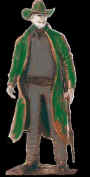
to Justin that there was something he needed to know. He sat in his
favorite recliner, which the light had supplied him, and set his cowboy
hat on his knee.
“A hate crime was committed five
years ago,” the light said. “Its final victim has
just died, and she will come to you, Justice. While you are waiting, I
want you to see what happened.”
The light parted and showed him a scene
from the past in the land of the living. A bus stop appeared on a downtown
street corner. It was after two o’clock in the morning, and the area was
only lit by a dim streetlamp. A slight-framed black man wearing a baseball
cap sat on the bench. “His name is Edmond Day,” the
light said.
Justin noticed how unassuming the man appeared, almost
frail.
“He
has just finished his shift at the hotel where he works as a bellhop,”
the light explained. “He sends his wages to his village in
Africa where his wife and three children still live.”
Justin
nodded in admiration and then noticed a woman approaching the bench.
“Her
name is Jenny Vandenburg,” the light said. “She
is a single mother of two fine boys and a nurses’ aide at the hospital
nearby. It is a paycheck-to-paycheck existence for her, but she is
determined to make life better for her family.”
“Hello,”
she said to the black man, Edmond Day. He tipped the bill of his ball cap,
and she sat next to him.
Then
a commotion down the street quickly drew their attention to two men
walking toward the bus stop. Justin’s throat clutched at the sight of
them. They wore chain-laced leather vests, camouflaged pants tucked into
their combat boots, and black gloves with the fingers cut off. Their heads
were shaved, and more alarming, on their arms, they displayed tattoos of
swastikas, exploding bombs, and racial atrocities. They’d just left
their jobs at a gas station and were headed for the Fourth Reich Bar, a
mecca of white supremacists and the Neo Nazi movement. Swapping obscene
words and laughing, they bantered back and forth as they approached, but
when they spotted the small black man sitting on the bus stop bench, their
demeanor suddenly changed. Justin felt the air become charged with
tension.
“What
do we have here?” the larger of the two skinheads said and elbowed his
buddy.
The
shorter skinhead stepped in front of the black man and loomed over him.
“Niggers don’t belong downtown,” he growled. “This is white
territory.”
“Leave
him alone,” Jenny said to the skinheads.
“Stay
out of this, bitch,” the larger man spat.
Jenny
glared at them both.
“I
am a peaceful man from Africa,” Edmond Day said in his own defense.
“It is good that I see you, yes?”
“Ah,
shut up!” The larger skinhead grabbed little Edmond Day, punched him,
choked him, and then frisked his pockets. In the struggle, the hat fell
off his head, and Jenny retrieved it from the ground. “Stop it,” she
shouted. She was trying to give the hat back, a clear attempt to distract
the skinheads, when the shorter skinhead pulled out a gun and shot Edmond
Day four times.
“Come
on,” the larger skinhead said, holding up a few dollars and a cheap
watch.
The
gunman cast Jenny a menacing glare. “She’s a witness.”
“Hurry
up and shoot the bitch.”
To
Justin’s horror, the skinhead shot her, not once but three times, though
the last two times he pulled the trigger, the gun was empty. The murderers
took off running in opposite directions, and Justin felt a suffocating
chill. “Did they get away with it?” he asked the light.
“The
killer was convicted and sentenced to life in prison,” the
light explained. “But this crime is not about him; it is about
his cohort, Gary Burnham. He too was convicted and sentenced to life plus
forty-eight years, but his lawyers won him a retrial based on a
technicality.”
“And...?”
Justin prodded.
“Instead of going to trial again, he copped a plea and got a
twelve year sentence. With time served, he is getting out of prison
today.”
“I
don’t understand,” Justin said. “The law specifically states that if
a murder occurs during the commission of a felony, all participants are
considered equally guilty of the murder.”
“But in this case, the District Attorney did not want to put Jenny
through another trial.”
“Why
not?”
“She was willing to testify again, mind you, but because of her
previous outbursts in court, the DA elected to accept the plea bargain.”
“What
happened?”
“You see,” the light began. “Jenny is a
flamboyant and outspoken woman who sometimes made her point with
profanity. In the original trial, when Burnham’s defense lawyer attacked
her credibility as a witness, she raised a verbal ruckus that some feared
might have prevented Burnham from getting a fair trial.”
“Is
that why he got a new trial?”
“No,”
the light said. “The appeals judge did not even consider that
argument because the technicality issue was enough to warrant a new
trial.”
“What
was the technicality?”
“The trial judge wrongfully accepted into evidence a video
confession made by Burnham’s accomplice to a television station, and
though he did not implicate Burnham, it was a video that the defense
claimed could have prejudiced the jury to the notion that Burnham was
guilty by association.”
Justin
began to get the picture. “And in the end, he got away with murder.”
“Exactly. It was a tremendous blow to Jenny’s crusade to see
that justice was served for Edmond Day’s murder.”
“But the shooter was put away for life.”
“Even so, the instigator of the violence was freed. That injustice
and the constant pain of her affliction were more than Jenny could
handle.” The light dimmed.
“Here she is now.”
“I can walk,” Jenny said as she stepped from the light and stood
before Justin. She wore a long white robe and held her palms out,
upturned. “There’s no
pain. I’m light as a feather.”
Justin stood. “There are no wheelchairs here, ma’am.”
Her rosy cheeks glowed for a moment, and then as if she came to a sudden
realization, her smile of amazement vanished. “Gary Burnham is back.”
The Greyhound bus squealed to a stop in a downtown terminal, and as
the doors opened with a hiss of air, passengers began to disembark.
Burnham muscled his way down the aisle, pushed a couple college kids out
of the way, and knocked an old lady back into her seat. “Young man?”
As his combat boots hit the blacktop, cool autumn air brushed over his
clammy shaved head. Earlier, on the bus, he’d changed into his leather
vest and camouflaged pants and tossed his go-to-court clothes out the
window. Now he was headed for the Fourth Reich Bar. He’d convinced the
parole board he’d abandoned his white supremacist beliefs; all men were
created equal, he’d told them. And he’d told them how sorry he was
about what happened to Edmond Day. It was all bullshit.
Truth was,
for the last four years, he’d relished the thought of shooting another
nigger. In prison, the black inmates couldn’t get to him because he’d
kept a circle of compatriots around him. His peers looked up to him,
thought he was a hero for the Aryan cause. They’d kept him safe from
black retribution, but working in the prison laundry, he was forced to
wash the niggers’ stinking socks and underwear. It was humiliating, and
though he couldn’t do anything about it then, now he was free, and he
would get his revenge; he was going to take back the city for the white
people.
The Fourth Reich Bar was busy as usual. Heavy metal music assaulted the
air; bourbon and schnapps flowed freely. A giant swastika hung on the wall
behind the bar, and black and white photos of Nazi storm troopers and the
holocaust were displayed all over the place. Pool balls cracked together,
and boisterous cheers rose. Burnham saw many familiar faces: Spike and
Dutch, and the Dayton brothers; Haskins and his clan were there too. In
the war for white supremacy, they’d all committed so-called hate
crimes and never got caught. Then, to Burnham’s delight, he saw many
new faces, which meant the movement had grown in his absence. Everyone’s
heads were shaved, and they all displayed their racist tattoos proudly. He
felt right at home exchanging knuckle greetings with fellow compatriots,
and he was quickly invited to the bar where a boilermaker awaited him.
“Welcome back,” the bartender said. His name was Mitch, and he was
the baddest son of a bitch in the place. He slid an army issue Colt across
the bar, and Burnham put it under his vest, offered Mitch a salute, and
downed the drink.
Pats on the back and high-fives went all around. Two more drinks awaited
him, and another three after that. Before long, the whole room was
spinning. He laid his head on his arms on the bar, closed his eyes, and
welcomed the sensation. About that time, the music suddenly changed to
rap, and a sharp pang of anger stabbed his guts. When he looked up, he
froze. There was a black bartender standing in front of him. Burnham
jumped up, staring in total disbelief, his heart beating hard. The
bartender looked like Edmond Day. At first Burnham figured it was the
booze wreaking havoc with his mind, but when the black man said,
“It is good that I see you, yes?” Burnham knew that something
incredible had happened.
“Hey, boys,” Burnham shouted over the rap music. “We got us a nigger
in here.” Cackling, he looked to his left and couldn’t believe his
eyes. He looked right, and panic swelled inside him. There wasn’t a
single white man in sight, just stern black faces with white-ringed
eyeballs. He whipped around only to find more black brothers gathering.
With venomous glares, they were inspecting the tattoos on his arms: the
swastikas, the storm troopers, and the nigger with a noose around his
neck. The rap music was getting louder, and he began to sweat.
“Mitch!”
But Mitch didn’t answer, and Burnham’s anger flared. His compatriots
had betrayed him. Obviously, they’d slipped out of the bar while his
head was down, and the blacks came in to...to what...to get revenge...?
Suddenly, a nauseating smell assailed him, the air wreaking of dirty
socks and piss-stained underwear, but a million times worse than anything
he’d encountered in the prison laundry. He cupped a hand over his mouth
and swallowed down a wave of vomit. Then he spotted the only other white
guy in the place, an old cowboy approaching from a dark corner. At least
he looked as if he might have been white at one time. He wore a bullet
riddled long coat that drizzled dirt and debris, and his face appeared to
be more bone than flesh. Tangled gray hair reached down to his shoulders.
As he neared, the stench grenaded, but for some unknown reason, the blacks
paid him no mind. “Who are you?” Burnham demanded.
The ghoul came within spitting range. “My name is Justin Graves,” he
said in a grating voice. “But you can call me Justice.”
“What do you want?”
“I
talked to Jenny Vandenburg and Edmond Day.”
“That’s
not possible,”
Burnham
replied. “They’re
dead.”
“I
talk to dead people,”
Justin said.
“Because
I’m
dead, too.”
“You’re
just a crazy old man.”
“Maybe you
think I look like this because it’s fun.” The words hissed through
Justin’s exposed molars.
Grimacing, Burnham looked the ghoul up and down. “You’re
looking really gnarly, man.
You should see an undertaker.”
“I
saw what happened that night; I know you were the instigator of the
violence.”
“So
what? I got away with it, didn’t
I?” He
glanced at the crowd of black men around him. “Where
did all these niggers come from?”
“They’re friends of mine,” Justin said. “And they’re not very
happy with you right now.”
“Screw
’em!”
“I’ll
make you a deal: denounce your Aryan allegiance, and I’ll assure you
safe passage out of this bar.”
“I
can take care of myself,”
Burnham said and slipped his hand under his vest where the Colt was
hidden.
“Better
yet, I’ll
help you start a new life,”
Justin said, sweetening the pot. “I’ll
line you up with a good job where you’ll
meet a beautiful woman who’ll
love you and give you children."
“You
can’t
do that.”
“I
have the power to do anything.
I’ll even rid you of those hateful tattoos.”
“You ain’t touching my tattoos, mister. What are you, some kind of
nigger lover?”
Justin simply nodded.
“Then you’ll die with the rest of them.” Burnham pulled the Colt and
shot Justin first. He staggered backward and clutched his chest.
Satisfied, Burnham whipped around and shot the bartender right between the
eyes. A feeling of power came over Burnham, and he twisted left, now
aiming at a wide-eyed black man sitting on the barstool. The gun banged
again and again and again. Black bodies were falling everywhere, and
Burnham let out a holler of total elation. But the next time he pulled the
trigger, the gun only clicked.
Alarmed, he looked up and saw Justin at the front door, waving goodbye.
“JUSTICE!”
The rest of the black men jumped him and beat him unconscious.
Two days passed, and yellow police tape remained strung across the
entrance to The Fourth Reich Bar. On the corner, the bus stop bench still
stood, a stoic reminder of where so many lives were ruined. Justin sat on
the bench between the misty forms of Jenny Vandenburg and Edmond Day, and
he realized there were actually two people murdered that night; only
Jenny’s death was not as instant as was Edmond’s. Hers had dragged on
for five torturous years.
“Hate is like a disease,” she said to Justin. “It spreads with no
compassion. I’m just glad Burnham is in jail where he belongs.”
Edmond put his arm around her and asked Justin, “Why did this man kill
so many of his friends in that bar?”
Justin shrugged innocently. “The police are baffled. Burnham wasn’t
even drunk when he started shooting everyone. Sometimes hate has no
boundaries.”
“But he killed a lot of innocent people, right?”
“Don’t you fret about them none, Mr. Day.” Justin shook his head.
“They were all guilty of something.”
Jenny sighed. “Are you sure Burnham won’t get off on a technicality
again?”
“He’ll spend his final days on death row,” Justin assured her.
“I’ve always wanted him to pay for what he did,” she replied.
“Even though he didn’t pull the trigger that night, he was just as
guilty of the crime.”
Justin tipped his hat to her. She’d
done the most courageous thing anyone could ever do; she’d
put herself in harm’s
way for a stranger and paid dearly for doing the right thing.
With a gust
of wind, the ghoul was gone.

|